
The 2023-2024 figures showed that the size of the industry, excluding those having an annual turnover of Rs 20 crore, could be Rs 30,652 crore, assuming no tax evasion.

States will remain "net gainers" of the proposed GST rate rationalisation exercise with their GST revenues, including devolution, estimated to be over Rs 14.10 lakh crore this fiscal, according to an SBI Research report released on Tuesday. It said that, as was evidenced in the earlier exercise of GST rate rationalisation in 2018 and 2019, an immediate reduction in rates can cause a short-term dip of around 3-4 per cent in month-on-month collections (roughly Rs 5,000 crore, or an annualised Rs 60,000 crore), revenues typically rebound with sustained growth of 5-6 per cent per month.

'Amazon, Meta, Google, Microsoft have large operations in India and rely on smooth trade and data flows.' 'Restrictions could raise their costs, limit AI chip exports, and complicate their India strategies.'

Full exemption for all health insurance premiums and reinsurance or a reduction in the GST rate from 18% to 5% on health insurance services is likely.

Afghans have deep self-respect and are the last people to put up with humiliation. Is it any surprise that relations between Afghanistan and Pakistan have touched an all-time low and the two countries are now at war? asks M R Narayan Swamy.
The change in the government's engagement with the economy's need for reforms is more nuanced than how analysts have so far perceived it, points out A K Bhattacharya.
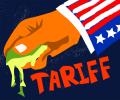
India needs to come together to deal with the 50 per cent punitive US tariffs on Indian products and stand up to any kind of bullying, Maruti Suzuki India chairman R C Bhargava said on Thursday. "It is our duty as Indians to do our very best to promote and maintain our dignity and respect and not give in to any kind of bullying in this matter... the nation has to stand united," Bhargava said at the company's 44th Annaul General Meeting in New Delhi.

'States should be compensated for the revenue loss for at least five years or beyond till the revenue stabilises.'

Recent developments - proposed changes to the goods and services tax (GST) rates and S&P Global Ratings' upgrade of India's long-term sovereign credit rating to BBB, with a stable outlook, - may not be enough to bring foreign investors back to Indian markets in a rush, feel analysts.

With lower GST rates taking effect, fast-moving consumer goods players face challenges in setting reduced prices for their products in round figures, but expect the magical price points to be restored within two months.

The proposed reforms in goods and services tax (GST) announced by the government last week, coupled with the eighth pay commission dole-out, is likely to push consumption-driven stocks - such as air conditioners (ACs), select automobiles, fast-moving consumer goods (FMCG), retail, and counters of quick-service restaurants (QSRs) - into higher orbit over the next few months, believe analysts.

Maharashtra has topped the list of states with the most favourable ecosystem for the growth of Farmer Producer Organisations (FPOs), replacing Madhya Pradesh, which has slipped to second place, according to the latest Ease of Doing Business for FPOs (EoDBF) ranking.

The rationalisation of goods and services tax (GST), announced on Wednesday, directly lowers the cost of everyday medical consumables, and also high-end therapies in oncology and rare diseases, helping reduce out-of-pocket patient expenditure and better adherence to medication.

Indian information technology (IT) service providers are expected to deliver low single-digit sequential growth in the first quarter (April-June) of 2025-26 (FY26), even as macroeconomic uncertainties continue to persist due to the volatile geopolitical environment.

As lower GST rates take effect on Monday, sales of air-conditioners, TV sets surged dramatically with buyers rushing to grab cheaper deals offered by retailers at the beginning of the Navratra festival.

Noting that recent uncertainties created by global tariffs have not impacted the Indian economy severely, Anuradha Thakur, secretary, Department of Economic Affairs, said the central government is hopeful that the recent goods and services tax (GST) rationalisation will ignite the much needed animal spirits in the financial sector.

While GST on ICE vehicles was brought down significantly, for electric cars it remained at 5 per cent.

Leading FMCG maker HUL said that it has received a demand notice of Rs 962.75 crore from the Income Tax Department and will go in for an appeal against the order. The notice relates to non-deduction of TDS on payment of Rs 3,045 crore to GlaxoSmithKline Consumer Healthcare (GSKCH) for the acquisition of Intellectual Property Rights of the Health Foods Drinks (HFD) business consisting of brands as Horlicks, Boost, Maltova, and Viva, according to a recent exchange filing.
Hindustan Unilever Ltd's (HUL's) second quarter 2025-26 (Q2FY26) consolidated revenue rose 2 per cent to Rs 16,250 crore, with low or flat volume growth. Demand remained stable but goods and services tax (GST) transition and prolonged monsoon hurt offtake.

Amid US-China trade tensions and economic vulnerabilities, India must seize the 'China +1' opportunity, deepen reforms, secure FTAs, and globalise its firms for long-term growth, suggests Ajay Shah.

The 50 per cent US tariff on Indian goods pose a downside risk to growth but the impact is expected to be short-lived for the economy, and consumption demand could see an uptick after the new goods and service tax (GST) rates are implemented which could even offset the external uncertainty, Chief Economic Advisor (CEA) V Anantha Nageswaran reckoned on Friday.


UBS has turned bullish on emerging markets (EM), including India, as it finds benign macro trends, positive momentum in earnings revisions, and resilient EM currencies helping these economies sustain higher valuations and attracting flows. Among regions, it has upgraded Mainland China to 'attractive' and China Tech to 'most attractive', while downgrading Philippines to 'neutral'.

With gains of over 28 per cent, Hero MotoCorp has emerged as the best-performing largecap automotive stock over the past three months. The rally has been driven by an improved outlook for the rural segment, higher demand during the ongoing festival season, and rising affordability following cuts in goods and services tax (GST) rates.

The Centre has proposed exempting life and health insurance policies for individuals from GST, Bihar Deputy Chief Minister and convenor of insurance GoM Samrat Choudhary said on Wednesday. Currently, health and life insurance premium attracts 18 per cent GST.

India's top cement producers delivered a solid July-September quarter (Q2) in 2025-26 (FY26), lifted by firmer prices, higher sales volumes, and a favourable base. Seasonal weakness and maintenance outages did dent sequential performance, but the overall picture remained positive - and the road ahead looks steady.

Leading automakers Maruti Suzuki, Hyundai, Mahindra, and Tata Motors saw a dip in dispatches to dealers in August amid dip in demand with many prospective buyers postponing their buys anticipating a reduction in vehicle prices on account of the new GST framework. The country's largest carmaker Maruti Suzuki India reported an 8 per cent year-on-year dip in dispatches of passenger vehicles in the domestic market last month.

While recalling the order, the bench agreed to the contention of the law officer that there was a "breach of principle of natural justice" as the government department was not accorded the hearing.

Real-estate firms have welcomed the Goods and Services Tax Council's reforms, expecting better affordability for buyers, spurring demand. The council has reduced the rate on cement from 28 per cent to 18 per cent, while the rate on sand lime bricks or stone inlay work and granite blocks has been cut to 5 per cent from 12 per cent.

Electric vehicle (EV) manufacturers breathed a sigh of relief after the GST Council on Wednesday night retained the concessional 5 per cent rate on EVs, though they now face competition from small petrol and diesel cars, which will attract a lower 18 per cent levy.

New Delhi will substantially reduce tariffs on industrial and agricultural goods while continuing to protect sensitive sectors. Tariffs on some agricultural products that are not traditionally considered sensitive will be brought down to zero, while in the case of relatively sensitive items, duties will be reduced in a graded manner and quotas will be imposed.

Among the Sensex firms, Mahindra & Mahindra jumped the most by 5.96 per cent. Bajaj Finance, Bajaj Finserv, Trent, ITC and HDFC Bank were also among the gainers. However, Maruti Suzuki India, Bharat Electronics, HCL Tech, NTPC, Power Grid, Infosys and Reliance Industries were among the laggards.
In a recent clarification, the Central Board of Indirect Taxes and Customs (CBIC) provided insights into the goods and services tax (GST) treatment of transactions involving vouchers. According to the CBIC, vouchers can be categorised into two types.

'Toll system can never end though the rates may vary from time to time. Toll is my brain child'

Trent reported decent margins in the second quarter (July-September) of 2025-26 (Q2FY26) but growth moderated. Same store growth was low single-digits. Trent's revenue growth decelerated in Q2FY26 at 17 per cent year-on-year (Y-o-Y) while area additions were offset by decline in revenue per square foot (sq ft).

'Ek baar aap GST dekh lo!' - Prime Minister Narendra Modi's gentle nudge to Finance Minister Nirmala Sitharaman in December last year sparked the beginning of a mammoth exercise to overhaul the tangled goods and services tax regime. And the final outcome is a significantly simplified system with lower tax rates and easier compliance for businesses.

'Growth will definitely continue to come most from the sub-four-metre SUV segment, primarily because that is where the heart of economy and affordability is. Naturally, that will keep pushing the share of that segment (in overall PV sales) higher.'

Credit quality of Indian corporate is expected to be stable in the second half of the current financial year (H2FY26), supported by easing monetary cycle, and declining inflation, coupled with income-tax relief and rationalisation of the goods and service tax (GST) rates, among others.

GST 2.0 may cushion consumers against US tariffs, but like the 2019 corporate tax cut, it risks being another tactical fix rather than a structural growth strategy, expects Debashis Basu.

The stock of automotive (auto) components major Bharat Forge has risen 14.6 per cent over the past month. Despite ongoing demand challenges, strong operating performance in the July-September quarter (Q3) of 2025-26 (FY26), a diversified revenue base, and expectations of a gradual recovery have lifted sentiment.
